
You spent ₹50,000 on ads last month and got 100 leads. Three of them became customers. Where did the other 97 go?
Most business owners blame the ads. But usually the ads did their job. The leads were lost somewhere between the form and the sale: a slow reply, no follow-up, the wrong offer, or a sales call to someone who was never a good fit. A lead generation funnel is how you see, and fix, each of those gaps. This guide explains what a lead generation funnel is, its stages, three real-world examples, and how to build one for your business step by step.
Key takeaways
- A lead generation funnel is the path a stranger takes to become an enquiry, then a qualified lead, then a customer.
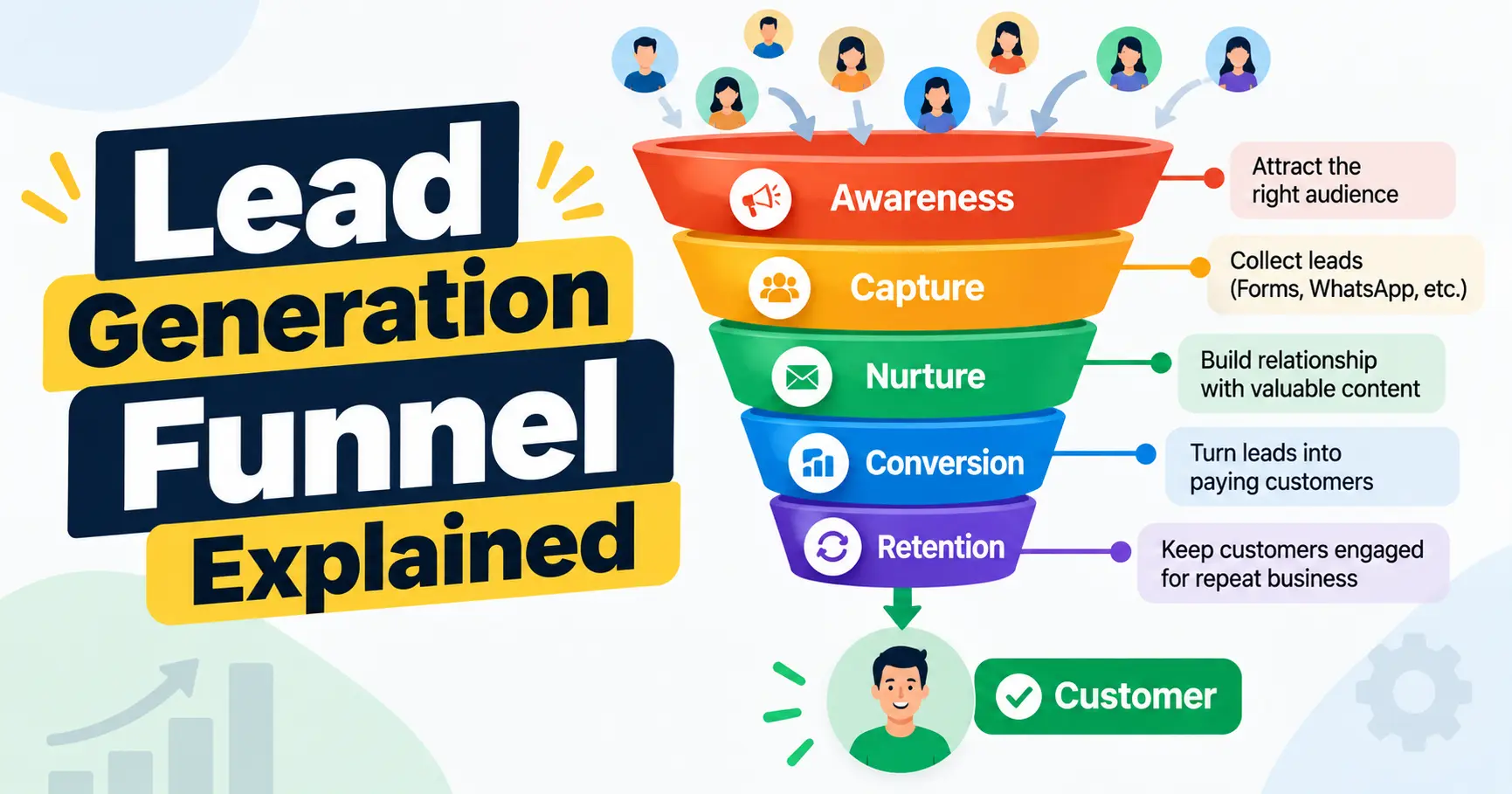
- It has five stages: awareness, capture, nurture, conversion and retention.
- Most leads are lost in the middle of the funnel, mainly because of slow or missing follow-up.
- You can only improve a funnel you measure. Track cost per lead, response time, booking rate and close rate.
- The best funnels speak to one ideal customer from the first ad to the final sales conversation.
What is a lead generation funnel?
A lead generation funnel is the step-by-step journey that turns people who have never heard of you into people who are ready to buy. It is called a funnel because many people enter at the top and fewer move forward at each step.
Marketers often split it into three parts: top of funnel (TOFU), middle of funnel (MOFU) and bottom of funnel (BOFU). Here is what each part means in simple terms:
| Part | What the customer is thinking | Your goal | Examples |
|---|---|---|---|
| Top (TOFU) | “I have a problem. What are my options?” | Get noticed by the right people | Meta and Instagram ads, Google search, blog posts, reels, YouTube |
| Middle (MOFU) | “Can this business solve it? Can I trust them?” | Capture the lead and build trust | Lead forms, WhatsApp chats, free guides, project photos, reviews, quick replies |
| Bottom (BOFU) | “Is this the right price and the right time?” | Turn interest into a sale | Site visit, demo, consultation, quote, offer with a real deadline |
The 5 stages of a lead generation funnel
1. Awareness: attract the right people
This is where strangers first see you. The key word is right. A thousand clicks from people who will never buy are worth less than fifty from your ideal customers. Your ads, posts and blogs should speak directly to one customer type and their real problem.
2. Capture: turn interest into a lead
Someone interested needs an easy way to raise their hand. That can be a Meta lead form, a website form, a click-to-WhatsApp ad or a phone call. Ask for only what you need: name, number and one qualifying question is usually enough. Every extra field reduces the number of people who complete it.
3. Nurture: follow up and build trust
This is the stage most businesses skip, and where most leads are lost. A new lead is curious, not committed. They need a quick reply, answers to their questions, proof that you have done this before, and a reason to take the next step.
Speed matters more than anything here. A well-known Harvard Business Review study found that companies that contacted online leads within an hour were nearly seven times more likely to qualify them than companies that waited longer.
4. Conversion: make the sale
Once a lead is qualified and warm, the goal is one clear next step: a site visit, a demo class, a consultation or a quote. Make it easy to book, confirm the time, send a reminder, and show up prepared with everything the lead has already told you.
5. Retention and referral: grow from happy customers
The funnel does not end at the sale. A happy customer can buy again, leave a review and refer friends. These leads cost you nothing and convert far better than ad leads. Ask for a Google review and a referral at the moment the customer is happiest, usually right after delivery.
Lead generation funnel examples
The numbers below are illustrative, to show how a funnel works. Your own numbers will depend on your industry, offer and market.
Example 1: Interior design studio
| Stage | What happens | Illustrative number |
|---|---|---|
| Awareness | Instagram reels of finished kitchens, shown to homeowners in nearby areas | 20,000 people reached |
| Capture | Click-to-WhatsApp ad: “Get 5 kitchen designs and a price range” | 120 enquiries |
| Nurture | Instant WhatsApp reply with photos, size question and price range | 70 share their requirements |
| Conversion | Free design visit booked on a fixed day and time | 25 visits, 8 projects signed |
| Retention | Review request and referral offer after handover | 3 referral leads |
Example 2: Coaching institute or trainer
| Stage | What happens |
|---|---|
| Awareness | YouTube shorts and blog posts answering common student questions |
| Capture | Free demo class or a downloadable study plan in exchange for a WhatsApp number |
| Nurture | Reminder before the demo, results of past students (with permission), answers about fees and batches |
| Conversion | Limited batch seats with a clear start date and easy payment |
| Retention | Advanced course offer and a referral discount for friends |
Example 3: Home service contractor (USA)
| Stage | What happens |
|---|---|
| Awareness | Google search ads and a Google Business Profile for “roof repair near me” |
| Capture | Click-to-call and a short online quote form |
| Nurture | Automatic text or email within minutes, with photos of past jobs and reviews |
| Conversion | Inspection booked on the calendar, quote shared on site |
| Retention | Maintenance reminder after 12 months and a review request |
How to build a lead generation funnel: step by step
- Define your ideal customer. Who are they, where do they spend time, what problem keeps them awake, and what makes them trust a business? Write it down. Everything else depends on this.
- Create an offer worth responding to. “Contact us” is not an offer. “Get 5 design ideas and a price range for your kitchen” is.
- Choose one or two traffic channels. Pick where your customer already is: Meta ads, Google search, Instagram, LinkedIn or SEO. Do one well before adding more.
- Make capture easy. A short form or a WhatsApp chat. Test it on your own phone.
- Reply within minutes, every time. Use an instant WhatsApp or email reply, ideally one that answers questions and qualifies the lead, not just “we’ll call you”.
- Qualify before you sell. Ask about budget, size, location and timeline so your team spends time on the right leads.
- Book the next step. Give two time options and confirm the slot in writing.
- Measure each stage and fix the stage with the biggest drop first.
Funnel metrics that actually matter
| Metric | What it tells you | How to calculate |
|---|---|---|
| Cost per lead (CPL) | How much each enquiry costs | Ad spend ÷ number of leads |
| First response time | How fast a lead hears back | Time from enquiry to first reply |
| Qualification rate | How many leads are a real fit | Qualified leads ÷ total leads |
| Booking rate | How many leads take the next step | Visits or calls booked ÷ qualified leads |
| Close rate | How well your sales process works | Customers ÷ visits or calls |
| Customer acquisition cost (CAC) | What one new customer really costs | Total marketing and sales spend ÷ new customers |
Want a quick estimate of what slow follow-up costs you? Try our free lead leak calculator.
Common lead funnel mistakes
- Judging ads only by cost per lead. Cheap leads that never answer the phone are expensive.
- Calling leads the next day. By then, they have spoken to someone else.
- No tracking. Without GA4, Meta Pixel and Conversions API set up properly, you can’t tell which ad brought which customer.
- One message for everyone. Generic ads attract generic, unqualified leads.
- Long forms. Ten fields on a mobile phone is where good leads give up.
- No follow-up after the first call. Many leads buy after the second or third conversation, not the first.
Tools you need for a simple lead funnel
- Traffic: Meta Ads, Google Ads, SEO and social media.
- Capture: Meta lead forms, a fast WordPress landing page, or click-to-WhatsApp ads.
- Follow-up: WhatsApp Business, or a WhatsApp AI agent on the official platform for instant replies.
- Tracking: GA4, Google Tag Manager, Meta Pixel and Conversions API.
- Lead management: a CRM, or even a well-organised Google Sheet to start.
- Automation: tools like n8n to connect forms, WhatsApp, calendar and sheets.
If you are starting with WhatsApp, our guide to WhatsApp Business automated messages shows how to set up instant replies in 10 minutes.
How we build lead funnels for our clients
At SKP DigitX, we start every funnel by learning your business and defining your ideal customer. Then we build the full path: Meta and Google ads, a landing page that speaks to that customer, proper tracking, and a WhatsApp AI agent that replies to every lead in seconds, qualifies them and books the visit. You can read more about how we work.
Not sure where your funnel is leaking? Book a free lead audit and we’ll show you.
Frequently asked questions
What is the difference between a sales funnel and a lead generation funnel?
A lead generation funnel focuses on attracting people and turning them into qualified leads. A sales funnel continues from there to the purchase. In practice, small businesses usually run them as one connected journey.
How long does it take to build a lead generation funnel?
A simple funnel with one ad campaign, a lead form and instant WhatsApp follow-up can be set up in one to two weeks. Improving it is ongoing, based on what the numbers show each month.
Which stage of the funnel loses the most leads?
For most small businesses, it is the nurture stage: the time between a lead enquiring and someone replying with a useful answer. Fixing response time is often the fastest way to get more customers from the same ad spend.
Do I need a website for a lead funnel?
Not always. Meta lead forms and click-to-WhatsApp ads can work without one. But a good website builds trust, ranks on Google and gives you a place to send people who want to know more.
Is a lead generation funnel useful for B2B businesses?
Yes. The stages are the same. B2B funnels are usually longer, use LinkedIn and email more, and need more nurturing before a sales call.
Final word
A lead generation funnel is not complicated. Attract the right people, make it easy for them to reach you, reply fast, guide them to one clear next step, and look after them after the sale. Measure each step, fix the biggest leak first, and the same ad budget will bring you more customers.